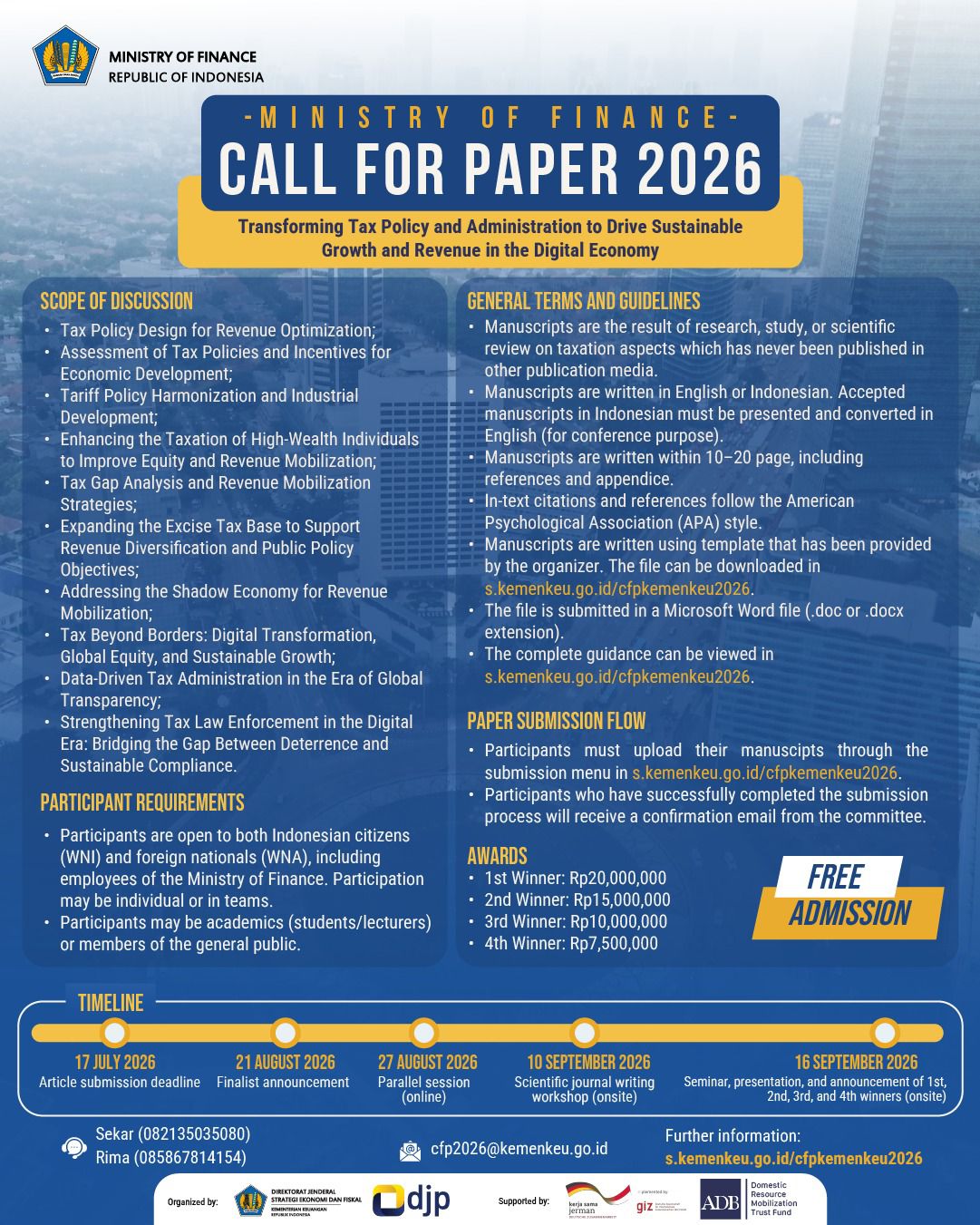
Ministry of Finance Call for Paper 2026
04-05-2026

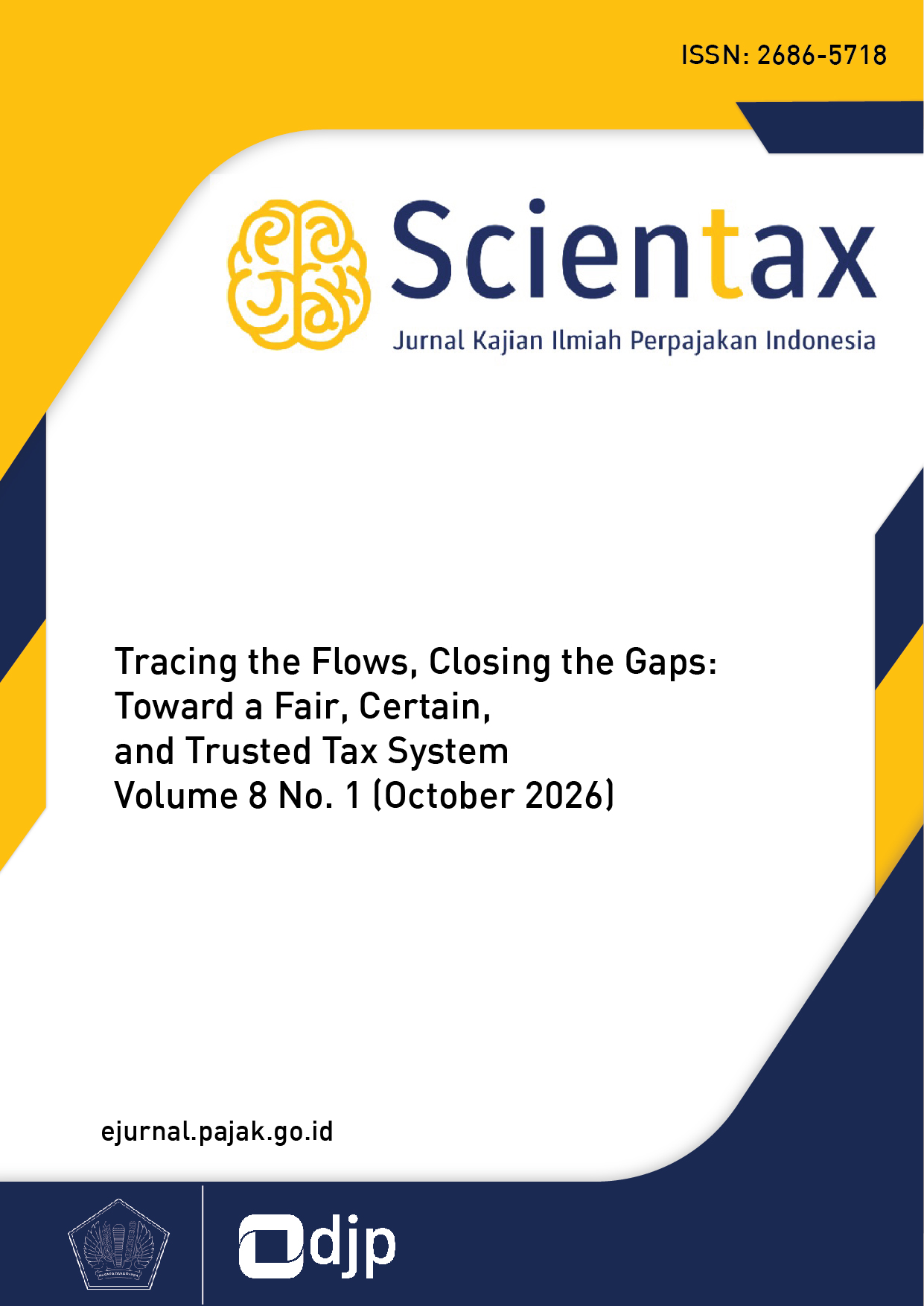
Greetings to all readers of Scientax!
Welcome to Volume 8, Number 1, October 2026 edition. This is the first issue of the journal’s eighth volume. This edition's title is “Tracing the Flows, Closing the Gaps: Toward a Fair, Certain, and Trusted Tax System.” Each of its seven articles asks where income and wealth actually go and why the tax system so often loses sight of them. Some articles follow money across borders. Others look for it in places a tax return rarely reaches, or ask whether the tax burden falls where it should. The final article turns to the people who keep the tax system running.
We begin at the border. Chandra Caesar Sitorus and Kadek Rama Maheswara Putra examine an overlooked inconsistency in Indonesia’s tax treaty policy. Indonesia’s position on the OECD Model Tax Convention excludes arbitration. However, its treaty with Mexico contains an arbitration clause, the only one in Indonesia’s treaty network. In addition, the Directorate General of Taxes' (DJP) Coretax administration system already provides for arbitration as the final stage of the Mutual Agreement Procedure (MAP). The authors employ normative legal research using statutory, conceptual, and comparative approaches. They conclude that arbitration is not required in the near term, for three reasons: no MAP case with Mexico has arisen, the treaty’s arbitration clause has not yet entered into force, and no domestic implementing regulations exist. Nevertheless, Indonesia must establish a clear and consistent position without delay. Should Indonesia decide against arbitration, that decision must rest on a sound legal basis, including an assessment of its constitutional compatibility. The authors recommend that arbitration be regulated in the Minister of Finance Regulation on MAP and that Indonesia reconsider its position on Part VI of the Multilateral Instrument.
Andri Puspo Heriyanto also examines tax treaties, but he asks a different question: in treaty-shopping cases, who actually enjoys the income? Drawing on the literature, the relevant regulations, and an illustrative audit case, he develops a conceptual framework he calls mini-CORPNET. The framework has three layers. The normative layer applies substance-over-form and beneficial-ownership criteria. The analytical layer classifies entities as conduits or sinks and traces actual flows. The evidentiary layer relies on entity-level documents and reconstructed cash flows. His most important contribution is a caution. Network analysis is useful for risk screening and audit selection, but it cannot by itself prove that a foreign recipient is not the beneficial owner. That determination still requires evidence of control, risk-bearing, and onward-payment obligations. The author proposes a four-stage examination sequence and acknowledges that data access and the absence of empirical testing remain open problems.
The next two articles address money that rarely appears on a tax return. Goradok Pande Raja Sinabutar examines how taxpayers can report crypto holdings on their annual income tax returns, and how those holdings can be verified when assets move between centralised exchanges and private wallets. Using legal sources, public data, hypothetical scenarios, and transaction screenshots from the 2022–2023 regulatory context, he identifies two information gaps. First, a year-end exchange balance may omit holdings kept elsewhere. Second, a traceable on-chain transfer does not by itself establish who owns the asset. He offers practical proposals: worked filing examples, a holdings-reconciliation worksheet, documented review of discrepancies, and targeted information requests through proper legal channels. He also notes their limits. Requiring taxpayers to disclose wallet addresses or quantities would require a clear legal basis and a proper proportionality test.
Muhammad Syarif Mansur turns to an area that has received little attention from tax researchers: campaign finance. Using the 2019 general election reports published by Bawaslu (the Election Supervisory Agency), he treats political contributions as a potential source of tax data. His mixed-methods analysis finds a substantial gap between reported contributions and actual campaign spending. He simulates contributions at the legal maximum and assumes they were funded from unreported income. On that basis, he estimates potential tax of up to Rp6.25 billion per contributing taxpayer. He recommends stricter review of campaign finance reports by Bawaslu and closer data sharing between Bawaslu and the DJP.
The next two articles take up questions of fairness. Mujtahid Subagyo applies Mirrleesian optimal tax theory to Indonesia’s wealthiest taxpayers. He uses data from Forbes, Knight Frank, the DJP, and the World Bank on approximately 5,443 individuals in the top income bracket in 2023. Through calibration and numerical simulation, he concludes that the current top marginal rate of 35% is below the optimum and that 50% to 75% would be more appropriate. Together with reduced avoidance and evasion, this change could raise up to Rp36 trillion in revenue. By his estimate, that would be enough to lift about 5.5 million people out of poverty. Readers may assess these figures differently, and we hope the article prompts a productive debate on how progressive Indonesia’s income tax should be.
Muhammad Miftakhul Romadlon and Jamik Safitri study public reaction to the VAT increase through YouTube comments. Initial lexicon-based labelling found that 58.3% of the comments expressed dissatisfaction. To check that this pattern was not an artefact of the labelling method, the authors trained two machine learning models. A Support Vector Machine reached 86.83% accuracy and Naive Bayes reached 83.19%, which supports the consistency of the labels. The authors conclude that public reaction can now be observed almost in real time and can inform tax policy.
The final article examines the people within the tax administration. Listra Lubis and Novita Dewi Pratanti apply the Job Demands-Resources framework to study how digital transformation affects public service motivation at the DJP. They analysed survey data from 210 employees using PLS-SEM. Efforts to reduce uncertainty lowered excessive workload and increased the perceived usefulness of the new systems. Heavy workload increased stress, and stress made it harder to integrate digital tools into daily work. Where staff found the systems useful, integration improved, and so did their motivation to serve. The hypothesised moderating effects were not supported, which suggests that reducing uncertainty acts directly as a job resource. Now that the core tax administration system is part of everyday work, the practical lesson is that structured communication and sound workload planning matter as much as the technology itself.
Taken together, the seven articles return to the same problem. The data already exists in campaign reports, on blockchains, in corporate networks, and even in comment sections. The difficulty lies in turning it into reliable evidence. That requires legal clarity, rigorous methods, and staff who trust the systems they use. None of the authors claims to have closed these gaps. Several are open about what their studies cannot yet show, and we consider that candour part of their value.
We thank the authors for their work and patience through revision, the reviewers for their time and expertise, and the editorial team for bringing this edition together. We hope these articles invite debate and further research, and we welcome your submissions for the next edition.
Happy reading!
Scientax: Jurnal Kajian Ilmiah Perpajakan Indonesia or Scientax is a tax scientific journal published by the Directorate General of Taxes and provides scientific research results in the form of studies, both theoretically and empirically, on issues and problems surrounding taxation. Every article published in Scientax is the result of studies and research sourced from literature studies, literature reviews, field research, best practices, and/or a combination of each of these scientific activities. Articles published in Scientax have been through peer review, evaluation, and editing by the editorial board, reviewers, and members of the editorial staff. Scientax is published twice a year, October and April, and is open to the public, practitioners, researchers, employees, and tax observers.
Tools


Indexed by